Home » Jazz Musicians » Ali Farka Toure
Ali Farka Toure
A unique tale of a world respected musician, who deep in his heart considered himself but a humble farmer. Ali Farka Touré was born in 1939 in the village of Kanau on the banks of the River Niger in the north west of Mali. He was his mothers’ tenth son but the first to survive infancy. When Ali was still an infant his father died while serving in the French army, and the family moved south along the river to Niafunké, the village Ali called home for the rest of his life. People make their living by farming, cattle herding and fishing. There is no tradition of music in his family, but he had a calling early on in life, becoming drawn to music by its power. He was a child of the river. In Niafunké, as in the most of Mali, the dominant religion is Islam and Ali was a devout Muslim. But in this part of the world Islam co-exists with an indigenous belief in the mysterious power of the Niger. It is believed that under the water there are spirits called Ghimbala, male and female djinns with their own character, history, symbolic colors and ritual objects, all vividly portrayed in the local mythology. These djinns control both the spiritual and temporal world. Those who have the gift to communicate with the spirits are called children of the river. He was mesmerized by the music played at Ghimbala spirit ceremonies in the villages along the banks of the Niger. He would sit and listen in awe as musicians sang and played the favored instruments of the spirits; djerkel single string guitar, njarka single string violin and ngoni four string lute, at the age of twelve he fashioned his first instrument, a djerkel guitar. Ali found it very easy and natural to learn to play. Early on however he suffered attacks caused by his contact with the spirit world. He was sent away to a neighboring village to be cured, and when he returned a year later he quickly became recognized for his power to communicate with the spirits. Many of his songs are about the spirits and he always traveled with his njarka violin as well as recordings of spirit music which he listened to whenever possible. He began to play borrowed guitars and found it easy to translate his traditional guitar technique to the Western instrument. He said that his only problem was in keeping all six strings happy by touching them as he was used to only playing the monochord.
Read moreTags
Ali Farka Toure with Ry Cooder: Talking Timbuktu

by Nenad Georgievski
These days the genre of desert blues boasts one of the most vibrant music movements around the world. The bands and musicians that are part of this genre come from an area that is spread across Western Africa that stretches from Mali to Libya gathering people of various ethnic groups. Artists such as Tinariwen, Terakaft, Boubakar Traore, Tamikrest, Bombino, Habib Koite, Vieux Farka Toure, Amadou and Miriam, to name but a few, can be seen and heard touring the world, ...
read moreAli Farka Toure and Toumani Diabate: Ali and Toumani

by Nenad Georgievski
Profound knowledge of African music is not a must to enjoy Ali and Toumani. This recording is the second collaboration between two legendary Malian artists, the now-deceased Ali Farka Touré and master kora player Toumani Diabaté. Ali Farka Touré has always been a truly exceptional and original guitarist and even in his death he remains the symbol of African guitar, as he was the first to introduce desert blues to the world. Diabaté is the world's foremost kora player and ...
read moreAli Farka Toure & Toumani Diabate: In the Heart of the Moon

by Nenad Georgievski
Mali may be one of the poorest countries in the world, but it surely is one of the richest when it comes to its folklore and tradition. There are places on this planet where music flows like a river and Mali is surely one of those places. In The Heart of the Moon is a collaboration between guitarist Ali Farka Toure and kora (lute-harp) player Toumani Diabate. Although they belong to different traditions and come from different ...
read moreAli Farka Toure: Red & Green
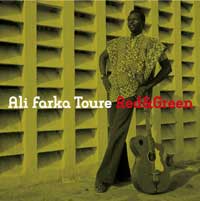
by AAJ Staff
Much has been said about the West African origins of the blues, but the only real concensus is that the music of Mali, particularly from the north, sounds remarkably similar to early African American forms that emerged first in the Mississippi Delta, then later in Chicago and beyond. This information comes as no surprise to the elder statesman of Malian blues, Ali Farka Toure, who has been rather outspoken in his assertion that American artists have borrowed from his music, ...
read moreAli Farka Toure: Red & Green
by Nenad Georgievski
The link between Africa and America, i.e. whether there is still a surviving link that exists from the period of the slave trade, has been a subject of numerous explorations, assumptions, projects, movies (Feels like Goin' Home by Scorsese). In all the regions worldwide there were people that went to all kinds of places, recording songs and thus evidencing the legacy of different folk cultures. One of the most evident examples about that link between Africa and North America is ...
read moreAli Farka Toure & Toumani Diabete, "Ali and Toumani"

Source:
Michael Ricci
Ali and Toumani contains the final recordings made by a pair of master musicians: the Malian guitarist Ali Farka Tour, who died in 2006, and the Cuban bassist Orlando “Cachato" Lopez, who died last year.
But this 11-track album -- the second collection of collaborations by Tour and the Malian kora player Toumani Diabet -- doesn't sound like death. Rather, it's an early contender for the warmest, most life-affirming listen of 2010. As it was on the 2005 Grammy-winning “In ...
read more
Ali Farka Toure/Toumani Diabate: New Album in February

Source:
JamBase
THE LATE ALI FARKA TOURE AND TOUMANI DIABATE WILL RELEASE FINAL COLLABORATIVE EFFORT FEBRUARY 23, 2010
Toumani Diabete World Circuit and Nonesuch Records are set to release Ali and Toumani, the second and last album pairing of the late Malian guitar virtuoso Ali Farka Toure and kora master Toumani Diabate, on February 23, 2010.
Recorded over three afternoons at London's Livingston Studios in 2005, with contributions from the late Orlando “Cachato" Lpez on bass, Ali and Toumani is the successor ...
read more

Jussi Reijonen
guitar
David G Bailis
guitarPhotos
Music
Videos
Similar


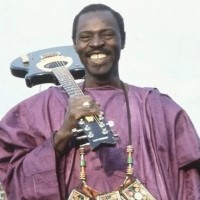
Ali Farka Toure
Instrument: Guitar
Born: 1939
Died: March 7, 2006



