Home » Jazz Musicians » Robert Pete Williams
Robert Pete Williams
There is a scarceness of authentic Blues artists who transcend the music and become the very essence of what they are conveying. They 'ARE' the Blues in its primordial form,beyond the field hollers and arhoolies, to the African griots, at its original source. One such individual was Robert Pete Williams, bluesman. From a Prison Cell to the Avant-Garde By Milo Miles Although Robert Pete Williams died in 1980 at the age of 66, he arguably remains the most avant-garde blues performer ever recorded. Few have approached his ability to evoke the torment of life in prison or bend language to cast an eerie spell over a chance encounter with a seductive woman. Williams could improvise precise, topical blues numbers with remarkable spontaneity. He had never been recorded when he was discovered in Angola penitentiary in Louisiana, convicted of murder. Like the country blues titan Leadbelly, Williams even sang his way to freedom. Yet he was no more than a moderate success on the folk-revival circuit in the 1960s, and the very density and originality of his blues must have been part of the reason. Today he is a shadowy memory, unknown outside blues circles. The release of Williams's prison recordings in 1959 caused a sensation with an earlier generation of fans. Blues revivals come and go, but too many of today's younger performers walk through the blues with a vocabulary limited to an ever-shrinking series of overused themes and guitar licks. Compared with such performances, Williams's blues comes as a draught of straight whisky after sips of warm soda. In particular, each of the field recordings made by the folklorist Dr. Harry Oster while Williams was still an inmate is gripping testimony. The first shock is the peculiar form of these blues. Williams repeats the first line at the beginning of each verse but boldly disregards the rest of routine blues structure. Williams grew up just north of Baton Rouge, and like many Delta blues musicians he favors long, spidery phrases spiked with hard beats. And like those of fellow eccentrics Big Joe Williams and John Lee Hooker, his guitar accents twine around the particular cadences of his voice. `This Wild Old Life' from `I'm Blue as a Man Can Be' shows Williams at his most stubbornly independent. While his singing could have a furry tone at times, here it cuts like a rusty razor as he describes the turmoil of wandering from town to town, homeless and alone.
Read moreTags
Robert Pete Williams: Robert Pete Williams

by Alan Jones
The music of Robert Pete Williams does more beyond telling a chain of personal and fictional stories. His music, like the works of great literary figures, is a life-breathing, transcendental product of experience. He perfected the effects of escape and dark satire in his work, which often has an almost supernatural quality.
Williams met a temporary fate brought on by violence and implied jealousy. Forced to defend himself in a scuffle at a bar, the bluesman shot a man to ...
read morePhotos
Music

Videos
Similar

Robert Johnson
vocals
Son House
guitar, slide
Blind Lemon Jefferson
vocals
Lightnin' Hopkins
guitar
Sleepy John Estes
guitar, acoustic
Mississippi Sheiks
band / ensemble / orchestra
Mance Lipscomb
guitar, acoustic
Mississippi Fred McDowell
guitar, slide
Junior Kimbrough
guitar
Furry Lewis
guitar, acoustic
Blind Willie Johnson
guitar, slide
Blind Boy Fuller
guitar, acoustic
Big Joe Williams
guitar
Josh White
guitar, acoustic
Captain Beefheart
vocals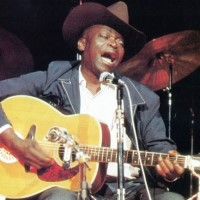
Robert Pete Williams
Instrument: Guitar
Born: March 14, 1914
Died: 1980



