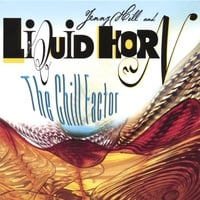
On The Chill Factor, Jenny Hill's third release as a leader, Hill distinguishes herself as a formidable
soloist as well as an accomplished composer-arranger and bandleader. Bebop meets Brazil on this
versatile outing, which also contains a couple of affecting ballads, an African flavored romp, a bit of
off-kilter funk and two inventive takes on jazz classics. Hill leads the way with some bold playing on
tenor, soprano and flute, accompanied by a stellar crew of fellow New Yorkers in trombonist Curtis
Fowlkes, pianist John DiMartino, vibraphonist Stefan Bauer, acoustic bass guitarist Jerome Harris,
electric bassist Oswaldo Amorim, upright bassist Dave Ambrosio and her husband Todd Isler on drums
and percussion. Together they strike a soulful accord on these nine invigorating tracks.
"I think it helps when you play with the same people for a long time," says Jenny. "I have played with
John, Curtis and Oswaldo for years and I began playing with Jerome and Stefan at least two years
before we recorded The Chill Factor. I think that contributed to the sound of this recording. Each guy's
coming from a different place musically but we do have this tight chemistry because we're friends and
we play together a lot."
Hill's friendship with Fowlkes, a charter member of the Jazz Passengers and current member of
Charlie Haden's Liberation Orchestra and Elliott Sharp's Terraplane, goes back to their tenure together
in the Big Apple Circus band. "I met Curtis there and immediately had a nice blend with him." Hill and
Fowlkes exhibit that easy blend on the frontline throughout The Chill Factor while also engaging in
loose, conversational exchanges on a few of the pieces here. The presence of Jenny's husband,
drummer Todd Isler, adds to the harmonious nature of this outing.
The use of vibes on several pieces lends a unique flavor to some of Hill's arrangements on The Chill
Factor. "I was trying to get a different color on this project and thought it would open up the sound,"
she says. "I was searching for something more organic, more natural sounding with a pure tone. I
began playing regular gigs in Brooklyn with Stefan, Todd and Jerome, and that's kind of how this whole
project evolved."
Hill ended up using Bauer on six of the tunes and then brought in pianist John DiMartino (a longtime
sideman to the late Latin jazz icon Ray Barretto and currently a member of Bobby Sanabria's Quarteto
Ache) for the remaining three. "As an arranger over the years I've grown to understand that you can't
just do the same thing over and over," she explains. "People's ears just get tired of it. So it's great to
introduce different colors, different feels and different voices into the mix and save some of the
instruments for later. I like to hold a couple surprises." DiMartino offers plenty of surprises on a savvy
reinvention of McCoy's "Passion Dance" along with the hypnotic "Monkeys of Kilimanjaro" and the funk-
oriented "Elephant Boogie Mania."
The mellow opener "Beautiful Madness" features some shimmering accompaniment from vibist
Bauer and is also highlighted by evocative harmonies between Fowlkes' trombone and Hill's tenor sax.
Spurred on by empathetic support from Harris on acoustic bass guitar and Isler on drums, Jenny
launches into a fluid, gutsy solo mid-way through the piece while Todd unleashes with a flurry on the
kit at the tag.
On her buoyant samba "Ocean Mist," Jenny switches to flute while Todd incorporates some frame
drum work. Again, the sound of Bauer's vibes lends a luminous quality to the proceedings while Harris,
a longstanding member of the Paul Motian Band, handles the bubbling groove with aplomb. Fowlkes
comes in at the end to contribute a spirited trombone solo.
Their inventive, grooving take on Tyner's "Passion Dance" combines the inherent modal feel of the
original with an undulating rhythm borrowed from Brazil. "I always liked that tune but I didn't want to
treat it the same way that everybody else does," says Hill. "So we used a rhythm that comes from the
Northeast part of Brazil called maracatu. It's usually created by a large group of drummers playing hand
drums. They practice all year long for the samba Carnival. When we were in Recife we snuck into this
rehearsal and checked one group out." Jenny digs in on tenor and blows with gusto on this clever
reinterpretation while pianist DiMartino solos adventurously over the baiao section of the piece. Says
Hill of her bandmate, "John is awesome. His choices here really helped the tune take off."
The introspective "Regrets Only" is a hauntingly beautiful ballad that showcases Hill's burnished
tone on tenor sax. "It's inspired by Horace Silver's Peace," she explains. Bauer turns in a particularly
expressive solo here with sensitve support from Isler on brushes and Ambrosio on acoustic bass.
"The Seventh Nerve," a Hill original which deftly switches time signatures from seven to six and back,
carries a subtle Middle Eastern influence in the voicings between Jenny's soprano sax and Curtis'
trombone. "We're supposed to sound like a caravan entering and leaving the desert," she explains. Hill
and Curtis engage in conversational exchanges near the end while drummer Isler overdubs kanjira (an
Indian hand drum) at the ending vamp to enhance the exotic vibe of the piece.
Miles Davis' "Nardis" is handled here as a seductive straight-eighths groove, with Hill's tenor
affecting a husky, warm-toned Getz-ian vibe. Bauer's vibes set a dreamy mood while Isler's hand
drums and Ambrosio's upright bass lend a subtle rhythmic undercurrent for this quartet piece.
Hill's affecting "Monkeys of Kilimanjaro" carries a vibrant South African flavor reminiscent of some
of Abdullah Ibrahim's writing. Amorim grooves the buoyant piece on electric bass, while DiMartino
comps simply behind Jenny's soaring flute solo. Isler again varies the dynamic of the piece by
alternating between frame drum and the traps set. "It's just a four measure tune, the shortest tune I
ever wrote," says Jenny. "There's only four bars of melody but it's layered, so the instruments enter at
different times and build it up, and then the piece dissolves at the end." Fowlkes elevates the
proceedings when he enters with an engerized trombone solo, and DiMartino solos nimbly against
Amorim's hypnotic bass ostinato and Isler's polyrhythmic pulse.
The ultra-funky "Elephant Boogie Mania" is a showcase for trombonist Fowlkes. Catch his playful
quote from "Rhapsody in Blue" in the middle of his solo here. Amorim also reveals some impressive
post-Jaco chops on electric bass. "When Curtis and I worked in the circus band together," recalls Hill,
"we would sit up in the bandstand and the elephants would have to pass under us. It was kind of a
rickety platform and it would sway when they walked by. So in honor of the elephants I decided to
feature the low instruments (trombone and bass) on this one."
"Your Last Breath" is a pensive minor key ode that Jenny wrote during that tense period in October
of 2002 when the D.C. sniper held the populace in the grip of terror for 23 days. "I was gigging there
and every time we went out to get gas or go to the store we thought, 'Wow, this could be your final
moment.' I wrote this haunting melody but then I thought it was too depressing, so I put it into three
and made the groove more uplifting." Bauer turns in a shimmering solo over Isler's shifting rhythm,
which morphs from hip time displacement to a straight 3/4 time swing pulse. Todd also erupts with a
dynamic drum solo before the piece resolves to some interactive conversing among all the instruments.
All the pieces here are tightly executed by these stellar musicians in The Chill Factor, each a
bandleader in his own right. But together they demonstrate an extraordinary chemistry in the service of
this budding bandleader and talent deserving of wider recognition. — Bill Milkowski
Bill Milkowski is a regular contributor to Jazz Times, Jazziz, Modern Drummer and Bass Player
magazines. He is also the author of "JACO: The Extraordinary and Tragic Life of Jaco Pastorius"
(Backbeat Books)
Show less