Home » Jazz Musicians » Marty Sheller
Marty Sheller
Marty’s first instrument was snare drum which he took up at age 10, and even though he switched to trumpet a year later, his love of percussion has played a major role in his career. He attended South Side High School in Newark, NJ and in 1957 he began college at Columbia University in New York City where he met fellow student and pianist Myron Schwartzman who introduced him to another student at the school, alto saxophonist Bobby Porcelli. They have all remained close friends since those days, when Sheller and Porcelli could be heard practicing Charlie Parker–Dizzy Gillespie unison lines in Marty’s dorm room. Marty made his professional debut in 1958, playing a summer gig with Porcelli, Schwartzman, and drummer Wilbur Bailey at the Woodbine Hotel in the Catskill Mountains. As young adults, they were passionate about the emerging music of Miles Davis, Art Blakey, Horace Silver and John Coltrane, and that summer was spent transcribing and playing songs from their recordings. In the fall, Marty joined a band led by tenor saxophonist Hugo Dickens that played at dances, fashion shows and cocktail sips sponsored by black social clubs in Harlem on Friday and Saturday nights. The clubs hired bands that could play rhythm and blues as well as Latin, and there was a group of musicians in New York that had grown up listening to both kinds of music and knew how to play them authentically. There were three bands working that circuit; Hugo Dickens, Pucho, and Joe Panama. Many musicians who played in these bands went on to become very influential in the jazz and Latin–jazz scene, including drummers Pete “La Roca” Sims, Phil Newsum and Steve Berrios, pianists Rodgers Grant and Arthur Jenkins, bassist Bill Salter, trombonist Barry Rogers, alto saxophonists Bobby Porcelli and Bobby Capers, and Hubert Laws who doubled on tenor sax, flute, guitar and vocals. In 1959 Marty began playing with composer, arranger, timbalero, vibraharpist and pianist Louie Ramirez, and in 1960 they put together a Latin–jazz band that played jazz songs with a Latin rhythm section, but the band found little work. The group included conga player Frankie Malabe, whom Marty sites as an important early influence. He spent many afternoons at Malabe’s house on Simpson Street in The Bronx (across the street and a few doors down from the infamous police station nicknamed “Fort Apache”) studying African and Afro-Cuban rhythms. Malabe would arrange two seats facing each other, put on a record, and demonstrate the conga parts by playing them on Marty’s knees, explaining the time-keeping patterns and their relationship to the clave. The Sheller/Ramirez band, finding few places that would hire them, discontinued rehearsals until conga player Sabu Martinez hired the entire group, minus Malabe, to play on “Sabu’s Jazz Espagnole” (originally issued on Al Santiago’s Alegre Label), considered by connoisseurs of Latin-jazz to be one of the genre’s quintessential recordings. Marty was working with another timbalero-vibraharpist, Pete Terrace, when he first met Mongo Santamaria at a club in the Bronx in 1961. In November of 1962, Marty got a call from Santamaria, who had dropped the flute-and-violins lineup of his charanga band in favor of a Latin-jazz sound with a frontline of trumpet, alto saxophone and tenor saxophone. Three days before Marty began rehearsals, Mongo needed a piano player for a weekend gig in a Bronx club. Chick Corea had just left the band and Donald Byrd recommended a young pianist from Chicago, Herbie Hancock. Byrd told Herbie to play a song for Santamaria that Herbie had recently recorded. The song was “Watermelon Man,” and Mongo asked Hancock to bring the music to Mongo’s rehearsal the next day (Marty’s first rehearsal with Santamaria). One week later when the band first played the song in public at The Blue Coronet in Brooklyn, the people went wild. Pete Long, Santamaria’s manager, phoned Orrin Keepnews at Riverside Records with the news and persuaded the producer to come out to the club (on Thanksgiving night 1962) to hear the reaction for himself. The next week, Keepnews recorded the song for release as a single. Issued on Riverside’s Battle subsidiary, “Watermelon Man” became a Top 10 hit. It features a trumpet solo by Marty, not playing in his usual bop-imbued style but rather blowing simpler, funky lines inspired by Melvin Lastie’s solo from the Barbara George hit “I Know.” Marty played with Santamaria, as well as composed, arranged, and eventually served as musical director through 1968, when he put down his trumpet due to embouchure problems. He continued, however, working with Santamaria as an arranger, composer, conductor and friend until the conguero’s death in 2003. Among Santamaria’s four Grammy-nominated Latin-jazz recordings Marty produced was the album “Dawn,” which won a Grammy for Best Latin Recording of 1977. Marty’s awareness of clave counterpoint, combined with a thorough grounding in hard bop, made him one of the most sought after New York arrangers. His jazz informed charts greatly contributed to the success of the salsa music issued by Fania Records from the late 60’s through the late 80’s. Along with Louie Ramirez and Luis Cruz Junior, he can be considered one of the architects of the Fania sound. Besides scoring the 1989 hit “El Gran Varon” and many other recordings and productions by Willie Colon, Marty’s arrangements can be heard on recordings by George Benson, Ruben Blades, David Byrne, Jon Faddis, The Fania All-Stars, Larry Harlow, Giovanni Hidalgo, Hector Lavoe, Arturo O’Farrill’s Afro-Latin Jazz Orchestra, Manny Oquendo’s Libre, Sabu Martinez, Ismael Miranda, T.S. Monk, Idris Muhammad, Luis “Perico” Ortiz, Charlie Palmieri, Louie Ramirez, Tito Puente’s Latin-Jazz Ensemble, Mongo Santamaria, Shirley Scott, Woody Shaw, The Spanish Harlem Orchestra, Steve Turre and many others. Marty collaborated with Charlie Gerard on the book “Salsa – The Rhythm of Latin Music” and arranged a Clio Award-nominated Budweiser TV commercial featuring the singing of Jose Feliciano. He composed, arranged and produced the music for the PBS TV mini-series “Oye Willie” and did the same for the NBC TV (New York) Hispanic affairs program “Visiones.” He has conducted workshops at Baruch College in New York City at The Milt Hinton Jazz Festival with Tito Puente’s Latin-Jazz Ensemble and with Jerry Gonzales’ Fort Apache Band. On October 1, 2005 Marty participated as a panelist in a conference at Harvard University coordinated by The Cultural Agents Initiative, The Smithsonian Institution and The Americas Society entitled “The Jewish Latin Mix; Making Salsa.” That same evening, The Lincoln Center Afro-Latin Jazz Orchestra premiered his composition “Counter Punch” featuring Bobby Porcelli on alto sax. On July 24, 2006 Marty was the subject of an oral history interview collected by The National Museum of American History (a part of The Smithsonian Institute). The interview is a key objective of the Online Project For Latino Jazz Documentation and Education. On February 19, 2008 Sheller fulfilled a dream with the release of “Why Deny,” the first recording issued under his own name on his own label, PVR Records. He has a second CD completed entitled “Libre” and continues composing and arranging for future releases of The Marty Sheller Ensemble. In December 2017 Marty Sheller is honored at his Alma Mater, Columbia University. As Guest Artist in Residence, Marty’s compositions were featured in the performances by the student jazz ensembles, with whom he worked with in rehearsal and master class settings during the week. Ensembles were directed by Sheller associates Chris Washburne, Vince Cherico, Ole Mathisen & Don Sickler, to a packed house of students, friends, family and musical associates at Symphony Space on December 8th, 2017.
Read moreTags
Marty Sheller: The Name Behind The Sound You All Know, Part 1
by Skip Heller
There are certain musicians who embody eras, even if they're not the player with their picture on the cover. In our contemporary musical climate, Greg Leisz comes to mind. Since 1991, he has popped up on hundreds of acclaimed albums, and without ever really changing his style, he has become centrifugal beyond the considerations of genre —without having made an album as a leader. But it's difficult to think of the last 35 years of American music without him as ...
read moreMarty Sheller: Libre

Source:
JazzWax by Marc Myers
Back in the 1960s, Marty Sheller did a sizable share of arranging for Mongo Santamaria. Marty was in the trumpet section of Santamaria's band and was on his all-important Latin-jazz rendition of Herbie Hancock's Watermelon Man in December 1962. Marty also had a hand in most of those cool albums Santamaria recorded featuring Latin versions of contemporary pop soul hits. Songs like the Fifth Dimension's Working on a Groovy Thing... And Stevie Wonder's Ma Cherie Amour... Clean, hip and oh ...
read more
Marty Sheller and Joe Magnarelli

Source:
JazzWax by Marc Myers
The history of the jazz trumpet backed by strings probably dates back to Louis Armstrong and the Song of the Islands in 1930. But in those days, strings meant a clutch of violins that sounded more like fiddles than an orchestral backdrop. Harry James began including a full string section starting in 1941, but the effect was more drama and movie soundtrack than hip accompaniment. Bebop musicians avoided longhair strings until Charlie Parker's Just Friends and April in Paris became ...
read more
Interview: Marty Sheller (Part 3)

Source:
JazzWax by Marc Myers
Many people think jazz went into a tailspin in the 1960s. In fact, out of commercial necessity, jazz hitched its wagon to many different music forms, from pop and soul to r&b and Latin. Each merger produced different genres. Soul-jazz resulted in organ-tenor sax combos like those recorded on Prestige. Funk-jazz was pioneered by Horace Silver and other Blue Note stars. Pop-jazz emerged with Wes Montgomery's Goin' Out of My Head on the Verve and A&M labels. Latin-jazz came in ...
read more
Interview: Marty Sheller (Part 2)
Source:
JazzWax by Marc Myers
Three forces transformed Latin music in the fall of 1962. First, the grittier, slinky funk of Horace Silver, Bobby Timmons and Art Blakey had a big impact on artists, shifting Latin music away from popular Cuban dances. Second, waves of Puerto Rican immigrants to New York in the 1950s had created a new youth market for rhythms emerging from the city's Hispanic neighborhoods, particularly East Harlem. Third, hit radio and teen dance crazes like the Twist (1960) and Mashed Potato ...
read more
Interview: Marty Sheller (Part 1)
Source:
JazzWax by Marc Myers
The name Marty Sheller may not ring a bell. But anyone hip to Latin-jazz is aware of his enormous contribution to the music. First, that's Marty's trumpet solo on Mongo Santamaria's 1962 hit recording of Watermelon Man. The single helped launch the boogaloo, a dance beat that merged Puerto Rican and Cuban rhythms with jazz and funk. The boogaloo not only influenced Lee Morgan and Art Blakey in the 1960s but also James Brown, who incorporated the funky rhythm and ...
read more
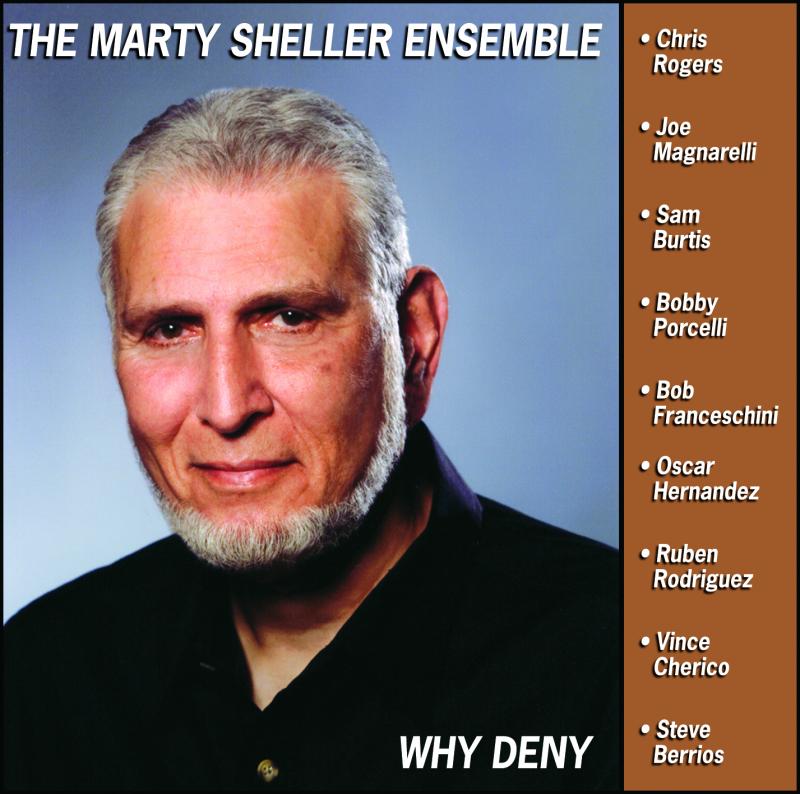
Veteran Latin-Jazz Arranger Marty Sheller to Release "Why Deny," His Debut Album, 2/19

Source:
Terri Hinte Publicity
Marty Sheller's long and busy career as a valued arranger-composer-producer for many of the biggest names in Latin jazz and salsa music--including Tito Puente, Willie Coln, Ruben Blades, Hector Lavoe, Larry Harlow, the Fania All-Stars, the Spanish Harlem Orchestra, and especially his close colleague Mongo Santamaria--left him little time to contemplate recording his own music. But he finally resolved to address that oversight at the urging of friends, organizing several sessions with nine of his favorite musicians. The result is ...
read more
Photos
Music
Videos
Similar

Benito Gonzalez
piano
Paoli Mejias
percussion
Jerry Gonzalez
trumpet
Louie Cruz Beltran
percussion
Manuel Valera
piano
Daniel Messina
drums
Chip Boaz
bass
Dave Percell
guitar.jpg)
Richie Vitale
trumpet
Michael Ross
bass
Bennett Paster
piano
Sam Bardfeld
violin
Marty Sheller
Instrument: Arranger
Born: March 15, 1940
Died: September 16, 2022
Publicist: Terri Hinte Publicity



