Home » Jazz Musicians » Alexander "Sandy" Courage
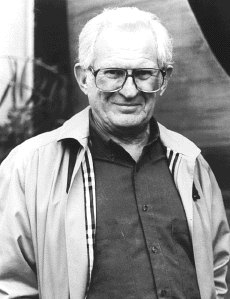
Alexander "Sandy" Courage
Alexander Courage Star Trek Fanfare Composer Alexander "Sandy" Courage won an Emmy Award as principal arranger for the ABC special Julie Andrews: The Sound of Christmas and was a nominee for his work on Medical Center.
Sandy Courage described his work as a conductor, arranger, and composer in network radio on such series as: The Screen Guild Theater, The Adventures of Sam Spade, and Hedda Hopper's This Is Hollywood.
Courage's entrance into feature filmmaking as an arranger was at MGM, his screen highlights on such musical classics as Showboat, The Band Wagon, and Seven Brides For Seven Brothers. He was composer for television at Revue Productions. He was composer on the MGM series National Velvet. Switching to 20th Century Fox, his work on such feature films as The Pleasure Seekers and Doctor Doolittle.
For television at 20th he worked on such series as: Daniel Boone, for which he composed dozens of episodes. He described maybe his most famous work on the series Star Trek for which he wrote the familiar fanfare, theme, and music for the two pilot episodes, as well as several later episodes.
Courage extensive work on The Waltons for which he composed over one hundred episodes and other shows include: Judd For The Defense (for which Courage wrote the theme and music for several episodes), Voyage to the Bottom of the Sea, and several Academy Award telecasts.
Courage's fanfare for the "Starship Enterprise," written in 1965 for the first of two Star Trek pilots, was heard throughout the three original seasons of the show and has been reprised throughout all the Trek feature films and several of the TV series, notably Star Trek: The Next Generation in the 1980s and '90s.
He won a 1988 Emmy as principal arranger for the ABC special Julie Andrews: The Sound of Christmas, and received Oscar nominations (both shared with Lionel Newman) for his adaptation scores for The Pleasure Seekers in 1963 and Doctor Dolittle in 1967.
Born in Philadelphia and raised in New Jersey, he received his degree from the Eastman School of Music in Rochester, N.Y. in 1941, then moved to California. He enlisted in the Army Air Corps in 1942 and became a bandleader at bases in California and Arizona.
After the war, he began working for CBS Radio, composing for such shows as The Adventures of Sam Spade, Detective and Yours Truly, Johnny Dollar. From 1948 to 1960, he worked as an orchestrator and arranger at MGM, including work on the musicals Show Boat, The Band Wagon, Seven Brides for Seven Brothers, Guys and Dolls, It's Always Fair Weather, Funny Face and Gigi.
Read moreTags
TV Theme Music Obituary
Source:
Michael Ricci
R.I.P/TV Theme as it fades into sunset, Original music that has helped define shows is becoming a product for nostalgia.
Earle Hagen and Alexander Courage, who died days apart this month, were maestros of a musical genre that faded some years before they did. They composed TV theme music, those signature snippets that sent Pavlovian signals to viewers. It's fair to say they don't make TV theme composers like them anymore. In fact, it's fair to say they don't make ...
read more
Music
Recordings: As Leader | As Sideperson

Videos
Similar

Ken Peplowski
woodwinds
Gordon Goodwin
composer / conductor
Todd Sickafoose
bass, acoustic
Manny Albam
arranger
Dave Pell
saxophone
Andy Quin
piano
Plas Johnson
saxophone
Sam Butera
saxophoneAlexander "Sandy" Courage
Instrument: Composer / conductor
Born: December 10, 1919
Died: May 15, 2008



