Home » Jazz Musicians » Beck
Beck
On his first DGC album, 1994's Mellow Gold, Beck demonstrated his ingenious ability to mix old and new styles with ease. The result was music that on one hand sounded familiar, yet surprised at every turn. On Odelay, Beck has further mutated his approach, taking it to a higher level.
The first cut on Odelay, "Devil's Haircut," sports a guitar riff reminiscent of Terry and the Pirates' "I Can Only Give You Everything" and features Beck's stream-of-consciousness lyrical flow. The title of the first single, "Where It's At," is a skewed reference to the John Lee Hooker album That's Where It's At. The song boasts Jimmy Smith-style keyboards that would be right at home on a Blue Note record. The vocals, however, are run through a vocoder, giving them a retro-futuristic vibe more akin to an old- school Africa Bambaataa track. "Sissyneck," with its carnival-flavored organ line, possesses a lap steel chorus hook that recalls the spirit of Hank Williams with more honky-tonk authenticity than a million mullet-haired country artists could ever hope to muster. "Derelict" sounds like Mike Millius covering an old Hoagy Carmichael number at a recreation center in the middle of everywhere.
Odelay is a collection of songs culled from ongoing recording sessions Beck conducted over the past two years whenever time and touring permitted. The album was produced by Beck and the Dust Brothers, a.k.a. John King and Michael Simpson, who are world-renowned for putting the boutique in the Beastie Boys' Paul's Boutique album and putting L.A. hip-hop on the map via their hits with Tone- Loc and Young M.C. Beck utilized the Dust Brothers' Silverlake Hills studio for the majority of Odelay, with two songs recorded elsewhere: "Ramshackle," produced with Tom Rothrock and Rob Schnapf of Bongload Records, and "Minus" with Mario Caldato Jr. and Brian Paulson.
Beck was born in L.A. to bohemian parents. His mother, Bibbe Hansen, was raised amid New York's Andy Warhol Factory art scene of the '60s and in the '90s was part of the underground L.A. punk-drag band Black Fag. His father David Campbell, a Canadian musician, bluegrass street musician. During his childhood, Beck was shuttled back and forth between his mother in L.A. and his paternal grandparents in Kansas. His grandfather, Al Hansen, was a pioneer in the avant-garde Fluxus movement, and in 1998, Beck helped put together a traveling art exhibition that paired his visual artwork with his late grandfather’s. During his teens he discovered the music of Sonic Youth and Pussy Galore. After hearing a record by Mississippi John Hurt at a friend’s house, however, he began playing his own postpunk brand of acoustic country blues.
Read moreTags
Dave Brubeck: Live From the Northwest, 1959

Source:
JazzWax by Marc Myers
Last week, I pulled a new album loose from an envelope and the first thought I had was, “Goodness, do we really need another live album from the Dave Brubeck Quartet?" The track list wasn't much help selling me on giving the CD a listen, with songs like When the Saints Go Marching In and The Lonesome Road. But because I spent an afternoon with Dave at his home this time of year back in 2010 and because Lydia Liebman ...
read more
Jazz Musician of the Day: John Hollenbeck

Source:
Michael Ricci
All About Jazz is celebrating John Hollenbeck's birthday today!
John Hollenbeck's versatility as a percussionist and composer is revealed in a body of work that challenges countless boundaries. Performances with Fred Hersh, Kenny Wheeler and Bob Brookmeyer have showcased Hollenbeck's melodic and sensitive small-group jazz drumming. His unique approach to big band work is evident as a member of Bob Brookmeyer's New Art Orchestra, the BMI Orchestra, Jim McNeely's Tentet and as a frequent guest with the Village Vanguard Orchestra. ...
read more
Jazz Musician of the Day: Bix Beiderbecke

Source:
Michael Ricci
All About Jazz is celebrating Bix Beiderbecke's birthday today!
Early jazz legend Leon Bismark [Bix] Beiderbecke was born on March 10, 1903, in Davenport, Iowa, a mid-sized midwestern city. He attended Davenport schools until 1920 and showed an early aptitude for music. His family disapproved of his interest in jazz and sent him to Lake Forest Academy [IL] in 1921, but the opportunity to play and hear jazz in nearby Chicago was too distracting and eventually led to his expulsion. ...
read more
Jazz Musician of the Day: Dave Brubeck

Source:
Michael Ricci
All About Jazz is celebrating Dave Brubeck's birthday today!
Brubeck's mother studied piano in England and intended to become a concert pianist; at home she taught piano for extra money. Brubeck was not particularly interested in learning by any particular method, but preferred to create his own melodies, and therefore avoided learning to read sheet music. In college Brubeck was nearly expelled when one of his professors discovered that he could not read sheet music. Several of his professors came ...
read more
Jazz Musician of the Day: John Hollenbeck
Source:
Michael Ricci
All About Jazz is celebrating John Hollenbeck's birthday today!
John Hollenbeck's versatility as a percussionist and composer is revealed in a body of work that challenges countless boundaries. Performances with Fred Hersh, Kenny Wheeler and Bob Brookmeyer have showcased Hollenbeck's melodic and sensitive small-group jazz drumming. His unique approach to big band work is evident as a member of Bob Brookmeyer's New Art Orchestra, the BMI Orchestra, Jim McNeely's Tentet and as a frequent guest with the Village Vanguard Orchestra. ...
read more
Jazz Musician of the Day: Bix Beiderbecke
Source:
Michael Ricci
All About Jazz is celebrating Bix Beiderbecke's birthday today!
As a boy, Bix Beiderbecke had a few piano lessons, but he was self-taught on cornet and developed an unorthodox technique by playing along with recordings. His family disapproved of his interest in jazz and sent him to Lake Forest Academy in 1921, but the opportunity to play and hear jazz in nearby Chicago caused frequent truancy and eventually his expulsion. After several months working for his father in Davenport, he ...
read more
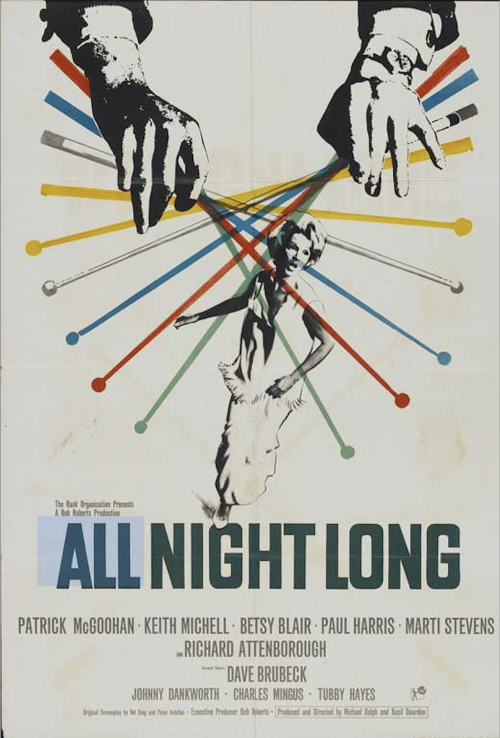
Brubeck and Mingus in 'All Night Long' (1962)
Source:
JazzWax by Marc Myers
Before big-beat pop and blues rock became the rage in London in 1963, jazz was still hip music for young adults. In 1961, All Night Long was filmed in London and released the following year. The jazz-themed neo-noir drama directed by Basil Dearden starred a range of British and American actors: Patrick McGoohan (Danger Man, The Prisoner), Marti Stevens, Paul Harris, Keith Michell, Richard Attenborough and Betsy Blair. The story is a reboot of Shakespeare's Othello and is set in ...
read more
Jazz Musician of the Day: Dave Brubeck
Source:
Michael Ricci
All About Jazz is celebrating Dave Brubeck's birthday today!
Brubeck's mother studied piano in England and intended to become a concert pianist; at home she taught piano for extra money. Brubeck was not particularly interested in learning by any particular method, but preferred to create his own melodies, and therefore avoided learning to read sheet music. In college Brubeck was nearly expelled when one of his professors discovered that he could not read sheet music. Several of his professors came ...
read more
Dave Brubeck and Mort Sahl
Source:
JazzWax by Marc Myers
Mort Sahl, a Canadian-born American comedian who helped pioneer socio-political satire in the 1950s and '60s, died on October 26. He was 94. For a brief moment in 1958, he hosted a pilot for a local San Franciso TV jazz show called Jam Session. He wasn't the show's planned host but he agreed to sit in. And why not? The group featured live at the Black Hawk was the Dave Brubeck Quartet. What's special about the following clip is the ...
read more
Brigitte Berman on Bix Beiderbecke
Source:
JazzWax by Marc Myers
Yesterday, I provided you with a link and password to watch Oscar-winning director Brigitte Berman's newly restored documentary, Bix: Ain't None of Them Play Like Him Yet (1981) for free. Brigitte generously made this possible. To recap, you can watch by going here and typing in this password: Solnicki. Don't forget to clear the existing password that's there now before typing in or pasting in the password provided. This password is good only until Friday at 10 p.m. (ET), so ...
read more