Home » Jazz Musicians » Bob Albanese
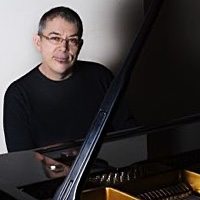
Bob Albanese
Albanese, a perpetual student, was granted a scholarship in 2002 to complete a B.M. and M.M. at the prestigious Manhattan School of Music in Jazz Composition. He met the challenge head on and while under the M.S.M. umbrella composed a number of new works including a Jazz Philharmonic piece entitled “Samba Esperança” that was performed by the Cincinnati Conservatory Philharmonic in April of 2006. He completed his formal degrees, BM and MM in May 2006 graduating with honors, receiving the William C. Borden award [for outstanding achievement in the field of Jazz].
Equally at home in jazz, Latin, pop, and theatrical musical settings, Jazz Pianist Bob Albanese has worked with a wide stylistic cross section of artists, many of considerable fame. Some of the notables he has performed, arranged and/or recorded with include Anita O’Day, Buddy Rich, Warne Marsh, Rita Moreno, Herb Ohta, Datevik Hovanesian, Leslie Uggums, Daphne Rubin Vega, Bill Watrous and a host of other Jazz artists ranging from Cab Calloway to Freddie Hubbard to Branford Marsalis.
He has been based in New York since 1980, but has also spent a fair amount of time on the road performing all over the continental U.S. and Hawaii (where he stayed for 2 years in the mid 90’s), Europe, Japan, Russia, South America, Mexico and the Caribbean.
While in Hawaii he acted as pianist for the Honolulu Symphony Pops and did numerous recordings and live performances with local and national artists including Phil Woods and James Ingram.
His longest stint of steady employment in N.Y.C. came in 1989 when he was hired as house pianist at the legendary Rainbow Room, playing there for a number of years as alternating Latin and American Jazz pianist. He also performed there as a solo pianist for some time upon returning to NYC from Hawaii.
As a studio musician, he has played and /or composed and arranged for over fifty commercial recordings throughout his years in New York (four under his own name); as well as music for film and T.V. His clients have included Sesame Street and Oprah Winfrey. In 2001, he was selected to serve his country as a Jazz Ambassador and led his band, Café Simpatico in performance, workshops and cultural exchange throughout war torn former Yugoslavia.
He is presently accompanist for Ben Vereen and performs with him regularly as group pianist and as solo accompanist for Mr. Vereen’s keynote speaking/performing engagements.
At the moment he is planning a tour with his trio to promote his upcoming new CD “One Way / Detour”.
Awards
William C. Borden award [for outstanding achievement in the field of Jazz]
Tags
Bob Albanese: Time Remembered

by Howard Mandel
Everything we remember is time past. How those memories live anew in the present is the subject of Time Remembered, pianist Bob Albanese's beautifully rendered solos and collaborations with bassist Eddie Gomez, drummer Willard Dyson, percussionist David Meade and (briefly on one track) “Furmina the Wonderdog." “It's a record of feeling which I hope will awaken a listener's private muse," says Albanese, a piano prodigy of Neptune, New Jersey who nowadays concertizes world-wide, accompanies notable artists across genres, ...
read moreBob Albanese: Time Remembered
by Dan Bilawsky
Memory is one persistent traveler. Whether we know it or not, memories always follow us on our journeys, influence our choice of direction, and work their way into our everyday encounters to some extent. Nobody is completely immune to the charms and ills carried in memories, but some are more susceptible than others. In fact, some readily choose to be susceptible, letting their memories take root in their work and allowing art to absorb and, subsequently, radiate experience. Such is ...
read moreBob Albanese: Time Remembered
by Mark Corroto
What of the lunchpail musicians? The blue collar jazz players like pianist Bob Albanese, are craftsmen who work to complete the jazz cathedrals whose foundations were laid by the masters. Albanese acknowledges the jazz icons, yet his artistry is as imaginative as the names written on the cornerstones. Proof positive is Time Remembered with guest Eddie Gomez. This disc follows his One Way/Detour Zoho Music (2009) and also has the pianist and longtime collaborator Willard Dyson at the ...
read moreTake Five With Bob Albanese

by AAJ Staff
Meet Bob Albanese: Bob Albanese was born in Newark, N.J. in 1957. Growing up and the Jersey shore, he began practicing the piano at age 8. At age 15, he won top honors in the Garden State Talent Expo which culminated in a solo performance at the Garden State Arts Center in Holmdel, N.J. This was the beginning of his professional career. Graduating Neptune High School (Neptune, N.J.) he moved to Boston where he studied at Berklee college of Music ...
read moreBob Albanese Trio: One Way/Detour

by John Patten
In 2008, pianist Bob Albanese took his trio into a studio to do an unplanned recording while performing in Florida, spinning a collection of first and second takes with saxophonist Ira Sullivan that became One Way/Detour.
As a composer, Albanese uses rhythm to lay the groundwork for his compositions. He builds on spare harmonic and modal ideas, which are bolstered by steady support from Tom Kennedy on bass and Willard Dyson on drums, to create solid original works. ...
read moreBob Albanese: One Way/Detour
by John Barron
When Bob Albanese was accompanying singer Ben Vereen in Palm Beach, Florida in early 2008, the pianist seized the opportunity to document his distinctive approach to modern acoustic jazz. With the aid of bassist Tom Kennedy and drummer Willard Dyson, Albanese called on legendary saxophonist Ira Sullivan, a longtime resident of Florida, to record One Way/Detour. In trio and quartet settings, Albanese leads the way through a fiery set of original and standard material.
The disc opener, “Major Minority," maintains ...
read moreBob Albanese: One Way / Detour
by Warren Allen
For his Zoho debut, New York pianist Bob Albanese shows a nice array of colors and sides with some excellent original compositions and a few great standards. His love of classic jazz is evident throughout, but so too is a desire to push some limits. Throughout the album, he shows a touch for angular Latin rhythms and edgy feels, combining them with the effortless swing that fueled Red Garland, Horace Silver and Bud Powell.
Many of the trio's songs start ...
read moreBob Albanese Trio with Ira Sullivan Releases One Way/Detour on Zoho Records
Source:
Jim Eigo, Jazz Promo Services
The Bob Albanese Trio with Ira Sullivan is ready to send lovers of jazz on a One Way/Detour. Their first release on Zoho Records (distributed by Allegro) is certain to satisfy the jazz purists and garner new listeners at the same time.
With a multitude of experience in jazz, classical, Latin, world, and theater, Albanese has few rivals when it comes to a well rounded career. He took his literal melting pot of piano experiences and wrapped it all into ...
read more
”Bob Albanese is a rhymer, a poetic soul whether he is thinking and talking or composing and playing. He has all the requisites-harmonic acumen, melodicism and swing. With all that he has nuance, that certain something that gives him distinction. He’s not radical, or fanatical but artistically he’s never on sabbatical.” —Ira Gitler (Jan. 2009), jazz historian and journalist, former New York editor of Down Beat magazine. He was given the Lifetime Achievement Award by the Jazz Journalists Association.
“Bob is a wonderfully creative pianist and his CD -One Way/Detour- proves it. He not only has a firm grasp on standards, his compositions are most interesting and he is someone who is not a traditionalist but knows the tradition which is a compliment I do not use very often. Bob was a Composition student of mine at Manhattan School of Music and is also a very creative orchestrator and arranger. More people should know about Bob Albanese.” —Michael Abene, Grammy winning Composer, Arranger, Producer and currently the Musical Director (Chefdirigent) of the WDR Big Band of Cologne, Germany on the 15th Nov. 2008
Primary Instrument
Piano
Location
New York City
Willing to teach
Beginner to advanced
Credentials/Background
1) Where do you/ did you teach?
New York University, Mannes College The New School, Manhattan School of Music (ensembles), Five Towns College, Master classes throughout former Yugoslavia i.e. the Balkans: Albania, The Republic of Kosovo, Serbia, Croatia, Slovenia, Montenegro, Bulgaria. I also teach privately and I do video conference lessons through Skype.
2) What do you/ did you teach?
Jazz improvisation, composition, harmonic, melodic and rhythmic development, clavé, 'the language of music' especially as it evolves through, of and into the essential Jazz Canon, the blues. the latin tinge. modes, compositional devices, constant note value improvisation, interpreting standards, jazz tunes: a vehicle for improvisation vs. set composition, ear training, arranging, musical story telling.
3) What do you like to teach during the masterclass?
I do a variety of things. A good set up would be to have at least 2 pianos and a chalk board, preferably with musical staffs but adequate if not. Drums, amps and music stands would be helpful for instrumentalists other than pianists. All instruments welcome. Knowledge of treble and bass clef, note values, chords, chord symbols, are recommended.
4) Some of the activities would be (not necessarily in this order):
a) discussion of everyones needs as pertains to improvisation, especially relating to the jazz tradition, BUT NOT LIMITED TO THE JAZZ TRADITION.
b) trading solo choruses back and forth.
c) chalk board explanations of the devices to be used in the actual playing demonstrations and group exercises.
d) the conflux of opposites as it relates to intervals relationships, consonance and dissonance in chord building and melodic (linear) development.
Clinic/Workshop Information
Photos
Music
Videos
Similar

Keith Jarrett
piano
Bill Evans
piano
Hank Jones
piano
Erroll Garner
piano
Gonzalo Rubalcaba
piano
Martial Solal
piano
Jessica Williams
piano
Kenny Werner
piano
Herbie Nichols
piano
David Kikoski
piano
Bruce Barth
piano
Bill Mays
piano
Ayako Shirasaki
piano
Eugen Cicero
piano
Rave Tesar
piano