Home » Jazz Musicians » Buddy Holly
Buddy Holly
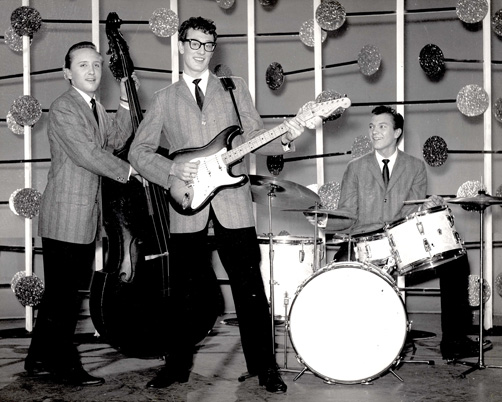
Pioneering rock 'n' roll musician Charles Hardin Holley, known as Buddy Holly, was born in Lubbock, Texas on September 7, 1936. He died in 1959 in a plane crash in Iowa. The youngest of four children of Lawrence and Ella (Drake) Holley, Buddy became one of the greatest legends of rock music.
His father worked as a tailor and salesman in a Lubbock clothing store, and though Lawrence did not play an instrument, he and Buddy's mom encouraged their children's musical skills.
At age five, Buddy appeared with his brothers in a talent show in the neighboring town of County Line. They won five dollars singing "Down the River of Memories." At age eleven Buddy took piano lessons, but quit after nine months. He started studying steel guitar, but eventually taught himself to play on acoustic guitar. At Hutchinson Junior High he and a friend, Bob Montgomery, formed a country music duo that later performed rock-and-roll music.
In the autumn of 1953, the duo added bass player Larry Welborn and started playing weekly on Lubbock radio station KDAV. The program was called "Sunday Party." At Lubbock High, Holly studied printing and drafting. He also worked part-time at Panhandle Steel Products. He stayed focused on his dream, however, of making his living as a musician.
In 1954 and 1955 the band made some demo records in Wichita Falls, but in 1956 Decca offered only Buddy a contract. Decca tried to turn him into a country artist. Two unsuccessful singles later, the label and Buddy parted ways.
Holly returned to Lubbock still determined to make it big in the music business. In February 1957 Holly, Welborn, who was later replaced by Joe B. Mauldin, Jerry Allison on drums, and Niki Sullivan on guitar went to the studio of an independent producer. Norman Petty's studio in Clovis, New Mexico, is where the band adopted the name the Crickets and formed its unique style. Holly's upbeat, pop sound became the transition between the raw rockabilly of Sun Records and the sophisticated pop rock music that would follow in the decades to come.
The Crickets soon signed a contract with Brunswick Records and Buddy signed a solo contract with Brunswick's Coral label. Holly's vocal style, with hiccup-like patterns, extra syllables, abrupt changes of pitch, and what one critic termed a playfully ironic, childlike quality. The Crickets first single, "That'll Be the Day," with "I'm Looking for Someone to Love" on the flip side, was released May 27, 1957. By June, it charted third on the pop charts and second on the rhythm and blues charts. It made Holly virtually an overnight success. His popularity quickly rivaled that of Elvis Presley.
Read moreTags
Buddy Holly Reconsidered
Source:
JazzWax by Marc Myers
Today in the Wall Street Journal (go here) I review Rave OnBuddy Holly, an album that will be released this coming Tuesday. It pairs 19 contemporary and established rock artists with songs associated with rock's least-known and most misunderstood founder. The result is expressionistic and interpretive, much in the way that If I Were a Carpenter (A&M) was when the CD was released in 1994. On that album, artists like the Cranberries, Sheryl Crow and Cracker took a shot at ...
read more
Same as It Ever Was: Buddy Holly Tries to Reason with His Label Boss

Source:
HypeBot
The secret recordings.
Disagreements between artist and labels have been happening since the invention of the recorded disc. Way back in 1956, Buddy Holly recorded several songs in Nashville including “That'll Be The Day". But but producer Owen Bradley reportedly hated rock n' roll, and the results were less than exciting.
Later Holly re-recorded “That'll Be The Day" at a different studio with his own arrangement. But...
according to ...
read more
Buddy Holly 50th the Day Music Didn't Die

Source:
All About Jazz
Sorry, Don McLean, but the music didnt die 50 years later, Buddy Hollys songs still alive in tunes we hear today.
Buddy Holly was the James Dean of his generation. But whereas Dean who died at 24 in a car crash in California was celebrated for his brooding screen presence, it was Hollys earnestness that defined him. At another time in history, he would have been called a nerd. The wreckage of a single-engine Beechcraft Bonanza was scattered ...
read more
Not Fade Away: Remembering Buddy Holly
Source:
All About Jazz
Next Tuesday marks the 50th anniversary of the plane crash that claimed the lives of Buddy Holly, Ritchie Valens and J.P. The Big Bopper Richardson.
In the current issue of Rolling Stone, Hollys friends, family and fellow musicians remember an artist who helped invent rock & roll as we know it today. Jonathan Cott revisits 1959s Winter Dance Party, which would become known as rocks Tour From Hell, as it wound its way across the frozen Midwest hitting places like ...
read more
Delbert McClinton Receives Personal Honor in Lubbock, Inducted into Hometown "Buddy Holly Walk of Fame"
Source:
All About Jazz
August 10, 2001 FOR IMMEDIATE RELEASE
DELBERT McCLINTON RECEIVES PERSONAL HONOR IN LUBBOCK INDUCTED INTO HOMETOWN “WALK OF FAME"
Also Honored with Spot on Buddy Holly Symposium Panel
LUBBOCK, Texas -- Delbert McClinton will be twice honored in his hometown of Lubbock, Texas both as an inductee into the “Buddy Holly Walk of Fame" on Wednesday, August 29 and subsequently as a panelist at the Buddy Holly Symposium on Thursday, September 6.
Delbert will be the recipient of the ...
read more
Music
Recordings: As Leader | As Sideperson

Videos
Buddy Holly
Instrument: Composer / conductor
Born: September 7, 1936
Died: February 3, 1959



