Home » Jazz Musicians » Frank Herzberg
Frank Herzberg
He became a violin maker in Markneukirchen - one of Germanys centres of instrument making and started in 1990 to study double bass at the Hochschule für Musik “Hanns Eisler” in Berlin with Kammervirtuose Gerd Reinke.
Frank won a scholarship to study at the renowned Berklee College of Music in Boston. There he was lucky to take classes with Charlie Banacos and Hal Crook in Jazz Improvisation and graduated from Berklee with the Bachelor of Music in Jazz Composition and Performance.
Frank returned to Berlin, where he completed his classical studies at Hochschule für Musik Hanns Eisler. Since 1997, Frank has lived in São Paulo, Brazil, where he works as a bassist with different jazz formations and is a member of the bass section in the Symphonic Band of São Paulo.
Frank Herzberg has appeared on nearly 60 CD's as a bassist, plays regularly with his own trio, and with the Marta Karassawa Quintet, John Stein Group, and the André Juarez Quartet, among others. He works also as a studio musician and producer for instrumental music in Brazil. He appears regularly at festivals giving concerts and workshops about improvisation.
During his carrier he has appeared on stage, in the studio, or in workshops with Horace Sliver, Antonio Sanchez, John Stein, Zé Eduardo Nazário, Ithamara Koorax, Bocato, Guilherme Franco, Teco Cardoso, André Juarez, Torsten de Winkel, Bob Moses, Jaques Schwartzbart, Steve Hass, Cornelius Claudio Kreusch, Andre Pawelski, and Chris Allen, among others.
Frank Herzberg works as a acoustic bassist in various orchestras in Brazil, including the Symphonic Band/São Paulo, Jazzsinfonic Orchester/São Paulo, and Orquestra Mediterrânia, where he has accompanied well-known musicians like David Liebman, Hermeto Pascoal, Egberto Gismonti, Ginga, and Airto Moreira, among others.
Tags
John Stein: Watershed

by Chris M. Slawecki
As his eleventh release on the label, Watershed continues the elegant and blissful creative marriage between guitarist John Stein and Whaling City Sound. A good marriage is based in compromise, in accommodating give-and-take, and Stein's give-and-take with this rhythm section of bassist Frank Herzberg, drummer Zé Eduardo Nazario and pianist Daniel Grajew creates beautiful, delightful music. Stein pours out Bobby Scott's “A Taste of Honey" with all the natural sweetness of its title for six luscious minutes. His ...
read moreJohn Stein: Watershed
by Edward Blanco
Jazz guitarist John Stein has produced many recordings throughout his career. Watershed is his fifteenth album and a special one at that, marking his retirement from academics and the beginning of a new chapter in his life. A former professor at Berklee College of Music (his alma mater), Stein is now fully engaged in producing the deep grooves and rhythm-based and breezy-styled melodies that make this album such a wonder to listen to, repeatedly. Recorded while on tour ...
read moreRodrigo Lima: Saga

by Chris M. Slawecki
“I fell in love with the jazz guitar--all kinds of jazz guitarists, from Jim Hall to Pat Metheny to Luis Bonfá, by listening to their records," explains Brazilian composer, arranger, bandleader and guitarist Rodrigo Lima. Saga luxuriously extends this jazz guitar love affair across the American and Brazilian continents--it was recorded in New York, Los Angeles, Rio de Janeiro and Curitiba--and across the two CDs of Lima's utterly magnificent recorded debut. Producer Arnaldo DeSouteiro elegantly ...
read moreFrank Herzberg Trio: Handmade
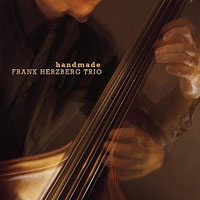
by Dan Bilawsky
The letter “B" has played a major role in Frank Herzberg's life. The Berlin-born bassist, who spent time honing his craft at Berklee, relocated to Brazil in 1997 and has been busy performing and recording music there ever since. While Herzberg's career choices probably have nothing to do with adding alliterative qualities to his biography, they have everything to do with his efforts to broaden and sharpen his mind and music. Herzberg and his trio work in ...
read moreTake Five With Frank Herzberg

by Frank Herzberg
Meet Frank Herzberg: Frank Herzberg has appeared on nearly 60 CDs as a bassist, plays regularly with his own trio, and with the Marta Karassawa Quintet, John Stein Group, and the André Juarez Quartet, among others. He works also as a studio musician and producer for instrumental music in Brazil. He appears regularly at festivals giving concerts and workshops about improvisation.During his carrier he has appeared onstage, in the studio, or in workshops with Horace Silver, ...
read moreRating: ***** (musical performance & sonic quality)
Produced & Engineered by Frank Herzberg Recorded on November 26 & 27, 2010 Total Time 57:17
Arguably the best jazz album of the year, "Handmade" was conceived, engineered & self-produced by the great São Paulo-based German bassist Frank Herzberg. Everything is impressive: the original material, the arrangements, the bright sound quality, the pristine mastering. And, specially, the soulful performances by this cohesive trio of giants: Herzberg on acoustic bass, Alexandre Zamith on acoustic piano & Rhodes, and Zé Eduardo Nazário on drums.
Primary Instrument
Bass, acoustic
Willing to teach
Intermediate to advanced
Credentials/Background
Frank Herzberg has offered a jazz improvisation course for professional musicians and music teachers in São Paulo Brazil since 1997. His unique method is based on two simple ideas: History and Repetition. History... After graduating from Berklee College of Music in Boston, and after private improvisation classes with Hal Crook, Bruce Gertz, Ed Tomassi and the legendary Charlie Banacos, Frank found himself with one urgent question: What to study first? With a shelf full of methods, transcriptions, and handwritten notes about improvisation, it was a difficult task to organize a systematic method of study
Photos

Music
Recordings: As Leader | As Sideperson

Flying Waltz
From: SagaBy Frank Herzberg
Don't Talk Crazy
From: HandmadeBy Frank Herzberg



