Home » Jazz Musicians » Arthur Blythe
Arthur Blythe
A singularly distinctive and uniquely distinguishable stylist, Arthur Blythe is considered one of the greatest alto saxophonist's of his generation. Blythe's beautiful, passionate and expressive sound validates his reputation as one of the most significant jazz musicians of our times. Blythe's work is notable for its exploration of harmony, group counterpoint, and unusual instrumentation. These features, coupled with his rapid, wide vibrato, his swinging style, and his interest in the standard jazz repertory, have won him praise from a wide audience.
Arthur Blythe was born 1940 in Los Angeles and grew up in San Diego where his parents moved 1944. He still performs the same alto saxophone that he and his mother bought 1957 in a second-hand store. Arthur began his career on the alto at nine years old and by 13 was playing in an R&B band. Moving back to LA in the late 50's, Blythe became a leading member of a lively and creative avant-garde jazz scene.
Arthur started working with the inimitable pianist-composer Horace Tapscott with whom he made his first recording in 1969, on Tapscott's "The Giant is Awakening."
Blythe settled in New York City in 1974 and has since built a stellar career while performing in a variety of jazz-oriented, world music environments. His aesthetic vision is broad enough to embrace that which is traditional, the modernist and the experimental impulse in contemporary jazz. Developing his baroque style at the instrument in the combos of Chico Hamilton, (75-77) Gil Evans, (76-78) Lester Bowie, (‘78), Jack DeJohnette, (‘79) and McCoy Tyner. (‘79)
Various Arthur Blythe ensembles have included African drums, Turkish Percussion, Violins, violas, electric guitar and tubs, in addition to piano, contrabass and drums. His individualistic instrumental blends are acknowledged for their recognizable, yet personal, musical statements.
Arthur's discography, as a leader or guest artist, extends to over 50 albums and includes ten seminal CBS Record albums, recordings with the Roots Band, The Leaders and The World Saxophone Quartet he made during the 80's. One of the last jazzers to receive the start treatment at Columbia records, altoist Arthur Blythe made a series of fine records that covered the distance between his loft jazz roots and the pop tastes of the time. "Lenox Avenue Breakdown"(’79) combined Blythe's singularly soulful delivery with a mix that seems more suited to now than then. Blythe wasted no time in recruiting a dream team of drummer Jack DeJohnette, tuba player Bob stewart, and bassist Cecil McBee on the bottom, joined by guitarist James Blood Ulmer in the middle, and flutist James Newton on top, plus percussionist Guillermo Franco to add an appropriately Spanish tinge now and again. This group plays like a band that had been together for years, not the weeklong period it took them to rehearse and create one of Blythe's masterpieces. Close to thirty years later, “Lenox Avenue Breakdown” still sounds new and different and ranks among the three finest albums in his catalog.
Read moreTags
Arthur Blythe: Lenox Avenue Breakdown

by Chris May
One of the most egregiously underestimated albums in jazz history, alto saxophonist Arthur Blythe's Lenox Avenue Breakdown was released on vinyl by Columbia in 1979 and on CD by Columbia (Japan) in 1995 and Koch Jazz in 1998. That's it bar a dodgy fourfer. Blythe fronts a septet completed by flautist James Newton, tubaist Bob Stewart, guitarist James Blood Ulmer, bassist Cecil McBee, drummer Jack DeJohnette and percussionist Guillermo Franco. Producer is Bob Thiele. The title track has the most ...
read moreSaxophone Colossi: An Alternative Top Ten Banging Albums

by Chris May
Miles Davis once said you could tell the history of jazz in four words: Louis Armstrong, Charlie Parker. You might want to add John Coltrane, you might even want to add Davis. But however you cut it, saxophones and trumpets have been the flag bearers of the music. Trumpets got things rolling and saxophones came into their own a decade later, during the swing era, when Coleman Hawkins and Lester Young legitimised the instrument as a solo voice.
read moreBasic Beauty: Arthur Blythe on Columbia

by Jakob Baekgaard
Back in 2016, BGO Records started reissuing the complete works of alto saxophonist Arthur Blythe (1940-2017) on Columbia. The first volume containing Lenox Avenue Breakdown (1979), In the Tradition (1980), Illusions and Blythe Spirit (1981) has already been reviewed on AAJ. The following two volumes complete the project of putting an important body of work from one of the great, unsung saxophonists in jazz history back into circulation. Arthur Blythe Elaborations/Light Blue: Arthur Blythe Plays Thelonious ...
read moreArthur Blythe, 1940-2017: A Remembrance

by Todd S. Jenkins
The emotive power of Arthur Blythe's bracing alto saxophone tone and flighty phrasing set him apart from many of his generation. A poet, a muezzin, an angry activist, a lamenting lover: Blythe conjured a broad array of sonic images through his nonpareil approach to music. The beloved altoist, who had battled Parkinson's disease for the past several years, passed away on March 27, 2017 at the age of 76. Blythe's musical cohorts and fans remember him with deep ...
read moreArthur Blythe: Lenox Avenue Breakdown / In The Tradition / Illusions / Blythe Spirit

by Jakob Baekgaard
Jazz-reissues are important because they help to write and rewrite jazz-history. Through reissues, the prominence of an artist is maintained and the canon is confirmed, but it can also be questioned and corrected. A double-disc from the excellent reissue label, BGO, brings four key records from leader and alto saxophonist, Arthur Blythe, back into circulation. The records, all released on Columbia, are: Lenox Avenue Breakdown (1979), In The Tradition (1980), Illusions (1980) and Blythe Spirit (1981). The ...
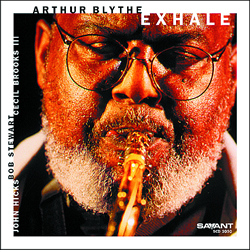
read moreArthur Blythe: Exhale
by Rex Butters
Arthur Blythe continues his fruitful association with producer/drummer Cecil Brooks III on Exhale, his latest for the Savant label, also teaming up with longtime partner and tuba player Bob Stewart, plus John Hicks on piano. The eclectic playlist conveys the many facets of the musicians involved.
Coltrane's "Cousin Mary" gets the party started in swing time with Stewart pumping the bass line. Blythe sneaks a little 'Trane phrasing in, but stays true to himself. His short, full toned solo sets ...
read moreA Fireside Chat With Arthur Blythe
by AAJ Staff
At one time, Arthur Blythe was part of the Columbia machine (not unlike the Miramax machine, how else do you explain the Gangs of New York phenomenon). Then trends took precedent over music and a young Wynton over a middle-aged Blythe (so the urban legend goes). Blythe still managed to record a classic Lenox Avenue Breakdown. Blythe is a Horace Tapscott throwback, having worked with the late Tapscott early in his career. I spoke with Blythe and we talked about ...
read moreJazz Musician of the Day: Arthur Blythe
Source:
Michael Ricci
All About Jazz is celebrating Arthur Blythe's birthday today!
A singularly distinctive and uniquely distinguishable stylist, Arthur Blythe is considered one of the greatest alto saxophonist's of his generation. Blythe's beautiful, passionate and expressive sound validates his reputation as one of the most significant jazz musicians of our times. Blythe's work is notable for its exploration of harmony, group counterpoint, and unusual instrumentation. These features, coupled with his rapid, wide vibrato, his swinging style, and his interest in the standard ...
read more
Jazz Musician of the Day: Arthur Blythe
Source:
Michael Ricci
All About Jazz is celebrating Arthur Blythe's birthday today!
A singularly distinctive and uniquely distinguishable stylist, Arthur Blythe is considered one of the greatest alto saxophonist's of his generation. Blythe's beautiful, passionate and expressive sound validates his reputation as one of the most significant jazz musicians of our times. Blythe's work is notable for its exploration of harmony, group counterpoint, and unusual instrumentation. These features, coupled with his rapid, wide vibrato, his swinging style, and his interest in the standard ...
read more
Jazz Musician of the Day: Arthur Blythe
Source:
Michael Ricci
All About Jazz is celebrating Arthur Blythe's birthday today!
A singularly distinctive and uniquely distinguishable stylist, Arthur Blythe is considered one of the greatest alto saxophonist's of his generation. Blythe's beautiful, passionate and expressive sound validates his reputation as one of the most significant jazz musicians of our times. Blythe's work is notable for its exploration of harmony, group counterpoint, and unusual instrumentation. These features, coupled with his rapid, wide vibrato, his swinging style, and his interest in the standard ...
read more
Jazz Musician of the Day: Arthur Blythe
Source:
Michael Ricci
All About Jazz is celebrating Arthur Blythe's birthday today!
A singularly distinctive and uniquely distinguishable stylist, Arthur Blythe is considered one of the greatest alto saxophonist's of his generation. Blythe's beautiful, passionate and expressive sound validates his reputation as one of the most significant jazz musicians of our times. Blythe's work is notable for its exploration of harmony, group counterpoint, and unusual instrumentation. These features, coupled with his rapid, wide vibrato, his swinging style, and his interest in the standard ...
read more
Jazz Musician of the Day: Arthur Blythe
Source:
Michael Ricci
All About Jazz is celebrating Arthur Blythe's birthday today!
A singularly distinctive and uniquely distinguishable stylist, Arthur Blythe is considered one of the greatest alto saxophonist\'s of his generation. Blythe\'s beautiful, passionate and expressive sound validates his reputation as one of the most significant jazz musicians of our times. Blythe\'s work is notable for its exploration of harmony, group counterpoint, and unusual instrumentation. These features, coupled with his rapid... Read more.
Place our Musician of the Day widget on your ...
read more
Jazz Musician of the Day: Arthur Blythe
Source:
Michael Ricci
All About Jazz is celebrating Arthur Blythe's birthday today!
A singularly distinctive and uniquely distinguishable stylist, Arthur Blythe is considered one of the greatest alto saxophonist\'s of his generation. Blythe\'s beautiful, passionate and expressive sound validates his reputation as one of the most significant jazz musicians of our times. Blythe\'s work is notable for its exploration of harmony, group counterpoint, and unusual instrumentation. These features, coupled with his rapid... Read more.
Place our Musician of the Day widget on your ...
read more
Anansi Trio Releases "On The Path" - Cover Music By John Coltrane, Bud Powell, Ornette Coleman, and Arthur Blythe

Source:
Mark Merella
The Anansi Trio is a group of like-minded musicians drawing from a wide range of musical influences. Using the language of jazz as their starting point they also fuse elements of Afro-Cuban and Indian music as well as other global traditions. Using percussion, saxophones and acoustic bass they create a music that’s unique and experimental yet remains accessible. With a diverse rhythmic approach and a focus on improvisation, The Anansi Trio hopes to put their own stamp on the American ...
read more
Jazz Musician of the Day: Arthur Blythe
Source:
Michael Ricci
All About Jazz is celebrating Arthur Blythe's birthday today!
A singularly distinctive and uniquely distinguishable stylist, Arthur Blythe is considered one of the greatest alto saxophonist\'s of his generation. Blythe\'s beautiful, passionate and expressive sound validates his reputation as one of the most significant jazz musicians of our times. Blythe\'s work is notable for its exploration of harmony, group counterpoint, and unusual instrumentation. These features, coupled with his rapid... Read more.
Place our Musician of the Day widget on your ...
read more
Jazz Musician of the Day: Arthur Blythe
Source:
Michael Ricci
All About Jazz is celebrating Arthur Blythe's birthday today!
A singularly distinctive and uniquely distinguishable stylist, Arthur Blythe is considered one of the greatest alto saxophonist\'s of his generation. Blythe\'s beautiful, passionate and expressive sound validates his reputation as one of the most significant jazz musicians of our times. Blythe\'s work is notable for its exploration of harmony, group counterpoint, and unusual instrumentation. These features, coupled with his rapid... Read more.
Place our Musician of the Day widget on your ...
read more
Jazz Musician of the Day: Arthur Blythe
Source:
Michael Ricci
All About Jazz is celebrating Arthur Blythe's birthday today! A singularly distinctive and uniquely distinguishable stylist, Arthur Blythe is considered one of the greatest alto saxophonist\'s of his generation. Blythe\'s beautiful, passionate and expressive sound validates his reputation as one of the most significant jazz musicians of our times. Blythe\'s work is notable for its exploration of harmony, group counterpoint, and unusual instrumentation. These features, coupled with his rapid... Read more. Place our Musician of the Day widget on your ...
read more

Rent Romus
saxophone, alto
Dafna Naphtali
vocals
Piero Bittolo Bon
saxophone, alto
George Starks
saxophonePhotos
Music

Videos
Similar

John Coltrane
saxophone
Anthony Braxton
woodwinds
Eric Dolphy
woodwinds
Ornette Coleman
saxophone, alto
Lee Konitz
saxophone, alto
Dave Douglas
trumpet
Charles Lloyd
saxophone
Andrew Hill
piano
Paul Motian
drums
Jack DeJohnette
drums
Jackie McLean
saxophone, alto
Archie Shepp
saxophone, soprano
Paul Bley
piano
Greg Osby
saxophone
Steve Lacy
saxophone, soprano
Pharoah Sanders
saxophone, tenor
Arthur Blythe
Instrument: Saxophone, alto
Born: July 5, 1940
Died: March 27, 2017



