Home » Jazz Musicians » Eli Newberger
Eli Newberger
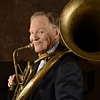
After growing up in New York, Eli went to Yale, where he majored in music theory. Although already an accomplished tuba player, Eli wished to serve people directly, and in his sophomore year started taking premedical courses. Perhaps the prospect of counting rests in an orchestra for much of his professional life helped this decision. But his interests in music were both in performance and in critical analysis, and the latter seemed to fit well with a career in science. His CV, incidentally, includes several publications on the development of jazz piano style. Eli graduated from Yale Medical School in 1966, and spent another year there as a house officer in internal medicine.
His next two years were spent in the Peace Corps, working in rural West Africa. After five years in a highly academic environment, this experience brought new perspectives on the realities of people’s lives. Working with other bright, socially aware, and idealistic Peace Corps people strongly influenced his appreciation of medicine in a social context. During this time, his values and priorities crystallized and Eli become interested in pediatrics. He returned to the U.S. to do his residency at Boston Children’s Hospital and Harvard Medical School. During his pediatric training, Eli was impressed by the many unmet needs of abused and neglected children and their families, and by the inadequate responses of the health and child welfare systems. Still a resident, he organized an interdisciplinary child maltreatment team in the hospital to improve the care of these children. This was the beginning of a commitment he has continued for two decades to the field of child maltreatment and family violence.
Always conscious of the 'big picture,' Eli has been instrumental in drawing attention to the underlying environmental circumstances contributing to child maltreatment. This has been, and continues to be, a major struggle against a prevailing victim-perpetrator framework that is typically accusatory and narrowly focused on individual behavior. A degree in epidemiology from the Harvard School of Public Health added more scientific rigor to Eli’s quest for a deeper understanding of child maltreatment. His broad perspective on the context of family violence has further shaped his substantial contributions to this field.
Eli’s contributions have been acknowledged with many honors and awards, including induction into Alpha Omega Alpha medical honorary society; the annual award for improvement of the welfare of children from the Massachusetts Society for the Prevention of Cruelty to Children; the Pantaleoni Award for the outstanding contribution to the betterment and welfare of children, awarded by the greater Boston Committee for UNICEF; the Commissioner’s Award for outstanding contributions in the prevention of child abuse and neglect, awarded by the U.S.
Read moreTags
Eli Newberger: Music Maker, Medicine Man
by Edward Bride
Such is the nature of jazz tuba that few prominent players are household names outside their genre. Can you name “the Art Tatum of the tuba" or a “the Clifford Brown of the tuba"? Many of these instrumental performers are part-timers. Only, don't tell Eli Newberger that jazz is his secondary field: it ranks solidly in a two-way tie with his role as physician, lecturer and consultant in pediatric matters.
To jazz fans, Newberger is perhaps best-known as co-founder and ...
read moreEli Newberger/Jimmy Mazzy/Butch Thompson: The Men They Will Become
by AAJ Staff
As a music critic, one must always try to have open ears, and appreciate music from different cultures, genres, and time periods. Also, one must recognize that a lot of hard work and money go into the making of a CD, and regardless of the artistic merit of the finished product, that effort should be commended. That being said, I must admit I don't like this record. The music on the disc is comprised mostly of old standards from the ...
read moreTubaist/Noted Physician Eli Newberger Profiled at AAJ
Source:
All About Jazz
Such is the nature of jazz tuba that few prominent players are household names outside their genre. Can you name “the Art Tatum of the tuba" or a “the Clifford Brown of the tuba"? Many of these instrumental performers are part-timers. Only, don't tell Eli Newberger that jazz is his secondary field: it ranks solidly in a two-way tie with his role as physician, lecturer and consultant in pediatric matters.
AAJ Contributor Edward Bride spoke with Newberger and his wife, ...
read more
Photos
Music
Recordings: As Leader | As Sideperson
Similar

Banu Gibson
vocals